2016年7月27日水曜日

My Featured Novel


I. About the Novel:The Secret Garden
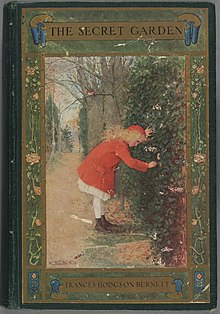

Houghton AC85 B9345 911s - Secret Garden, 1911 - cover.jpg
 
This is a novel by Frances Hodgson Burnett. It was initially published in serial format beginning in 1910, and was first published in its entirety in 1911. It is now one of Burnett's most popular novels, and is considered to be a classic of English children's literature. Several stage and film adaptations have been produced.

Works Cited (参考文献)
"The Secret Garden." Wikipedia. Wikimedia Foundation, n.d. Web. 19 July 2016.


ll. Version of the Movie in the Mass Media

A.BBC Drama Version in 1975


B.Movie Version in 1993


IIl. About the Author:Frances Hodgson Burnett
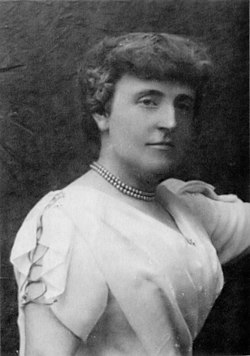
Portrait photo of Burnett in her forties

 She was an English-American novelist and playwright. She is best known for the three children's novels Little Lord Fauntleroy (published in 1885–1886), A Little Princess(1905), and The Secret Garden (1911).
Frances Eliza Hodgson was born in Cheetham, England. After her father died in 1852, the family fell on straitened circumstances and in 1865 immigrated to the United States, settling near Knoxville, Tennessee. There Frances began writing to help earn money for the family, publishing stories in magazines from the age of 19. In 1870, her mother died, and in 1872 Frances married Swan Burnett, who became a medical doctor. The Burnetts lived for two years in Paris, where their two sons were born, before returning to the United States to live in Washington, D.C., Burnett then began to write novels, the first of which (That Lass o' Lowrie's), was published to good reviews. Little Lord Fauntleroy was published in 1886 and made her a popular writer of children's fiction, although her romantic adult novels written in the 1890s were also popular. She wrote and helped to produce stage versions of Little Lord Fauntleroy and A Little Princess.
Burnett enjoyed socializing and lived a lavish lifestyle. Beginning in the 1880s, she began to travel to England frequently and in the 1890s bought a home there where she wrote The Secret Garden. Her oldest son, Lionel, died oftuberculosis in 1890, which caused a relapse of the depression she had struggled with for much of her life. She divorced Swan Burnett in 1898, married Stephen Townsend in 1900, and divorced him in 1902. A few years later she settled inNassau County, Long Island, where she died in 1924 and is buried in Roslyn Cemetery.
In 1936 a memorial sculpture by Bessie Potter Vonnoh was erected in her honour in Central Park's Conservatory Garden. The statue depicts her two famous Secret Garden characters, Mary and Dickon.

Works Cited (参考文献)
"Frances Hodgson Burnett." Wikipedia. Wikimedia Foundation, n.d. Web. 19 July 2016.


IV. My Reaction

A. Reaction Point - Theme
  • The purpose the writer has for creating the story.
  • The castle and the garden creations worldview of British.
  • What is the thought that the author was put in the "Secret"?

B. Reaction Point - Characters
  • Characters are the people in a story.
  • Main characters are Mary, Dickon, and Colin.
  • They each steps up each other.

C. Reaction Point - Symbolism
  • Symbolism are concrete things in a story that stand for larger, more abstract ideas.
  • Afternoon-Tea symbolizes British culture.
  • I think the garden symbolizes Mary’s mind.

D. My General Opinion
Mary was the girl who is selfish and lacks charm at first. I think Mary's heart is compared to a garden in this story. And I interested in British garden. So, I'll deepen more consideration.

2016年7月14日木曜日

My Featured Fashion Show Blog

Louis Vuitton 2015 Spring Summer Show


I. About the Clothing Brand
Louis Vuitton Malletier, commonly referred to as Louis Vuitton or shortened to LV, is a French fashion house founded in 1854 by Louis Vuitton. The label's LV monogram appears on most of its products, ranging from luxury trunks and leather goods to ready-to-wear, shoes, watches, jewelry, accessories, sunglasses and books. Louis Vuitton is one of the world's leading international fashion houses; it sells its products through standalone boutiques, lease departments in high-end department stores, and through the e-commerce section of its website. For six consecutive years (2006–2012), Louis Vuitton was named the world's most valuable luxurybrand. Its 2012 valuation was US$25.9 billion. The 2013 valuation of the brand was US$28.4 billion with revenue of US$9.4 billion. The company operates in 50 countries with more than 460 stores worldwide.


Works Cited (参考文献)
"Louis Vuitton." Wikipedia. Wikimedia Foundation, n.d. Web. 14 July 2016.


II. About the Designer


Nicolas Ghesquière (French pronunciation: born 9 May 1971) is a French fashion designer and the current creative director of the house of Louis Vuitton. (owned by LVMH).
On 4 November 2013, he officially replaced Marc Jacobs at Louis Vuitton as creative director for the women's collections.On 5 March 2014, Ghesquiere had his first show under the LV brand.

Works Cited (参考文献)
"Nicolas Ghesquiere." Wikipedia. Wikimedia Foundation, n.d.Web. 14 July 2016.


III. My Reaction


A. Reaction Point - accessory
・something such as a bag, belt or jewellery that you wear
・bag, belt, necklace, pierced earring etc...
・I think various dress is made of accessaries.

B. Reaction Point - coiffure
the arrangement of the hair
・long hair, short hair, dark hair, and light hair etc...
・There are many models of long brond hair.


C. Reaction Point - makeup
・cosmetics applied to the face to improve or change your appearance
・point make, color make, trend make, nudie make etc...
・A trend make of its year and a make which matches fashion are being taken in.

D. My General Opinion
I think a fashion show is the place where a worldview of its brand shows in a surface. We can know a collection of its brand through a fashion show. So, fashion show may an important place.


2016年6月29日水曜日

My Featured Film

A Christmas Carol(1935)


I. About the Film

「christmas carol 1935」の画像検索結果 "A Christmas Carol" is a 1935 British fantasy film directed by Henry Edwards and starring Seymour Hicks, Donald Calthrop and Robert Cochran. Hicks appears as Ebenezer Scrooge, the miser who hates Christmas. It was the first sound version of the Charles Dickens classic A Christmas Carol, not counting a 1928 short subject that now appears to be lost. Hicks had previously played the role of Scrooge on the stage many times beginning in 1901, and again in a 1913 British silent film version.


Works Cited (参考文献)
"Scrooge (1935 Film)." Wikipedia. Wikimedia Foundation, n.d. Web. 21 June 2016.


II. Versions of the Film


According to the YouTube, there are six film versions of the story that were released to theaters and three TV movie versions. These are listed below with links (to the extent available).

A Christmas Carol(1901)
A Christmas Carol(1910)
A Christmas Carol(1949)
A Christmas Carol(1951)
A Christmas Carol(1999)
A Christmas Carol(2009)


Works Cited (参考文献)
XmasFLIX. "Scrooge (or Marley's Ghost) (1901) "A Christmas Carol" First Film." YouTube. YouTube, 19 Dec. 2011. Web. 21 June 2016.


III. About the Lead Actor-Seymour Hicks


Seymour Hicks was a British actor, music hall performer, playwright, screenwriter, actor-manager and producer. He became known, early in his career, for writing, starring in and producing Edwardian musical comedy, often together with his famous wife, Ellaline Terriss. His most famous acting role was that of Ebenzer Scrooge in Charles Dickens's  A Christmas Carol.
Making his stage début at the age of nine and performing professionally by sixteen, Hicks joined a theatrical company and toured America before starring in Under the Clock in 1893, the first musical revue ever staged in London. Following this, he starred in a revival of  Little Jack Sheppard at the Gaiety Theatre, London which brought him to the attention of impresario George Edwardes. Edwardes cast Hicks in his next show, The Shop Girl, in 1894. Its success led to his participation in two more of Edwardes's hit "girl" musicals, The Circus Girl (1896) and A Runaway Girl (1898), both starring Terriss. He first played the role of Ebenezer Scrooge in 1901 and eventually played it thousands of times onstage. Hicks, along with his wife, joined the producer Charles Frohman in his theatre company and wrote and starred in a series of extraordinarily successful musicals, including Bluebell in Fairyland (1901), Quality Street (1902), The Earl and the Girl (1903) and The Catch of the Season (1904).
Hicks used his fortune from these shows to commission the building of the Aldwych Theatre in 1905 and the Hicks Theatre in 1906, opening the latter with a new hit show, The Beauty of Bath. His stage performances were less successful in later years, and he opted instead to star in music hall tours, including Pebbles on the Beach (1912). He continued to write light comedies, the most popular of which was The Happy Day (1916). On film, he first appeared in Scrooge andDavid Garrick both from 1913. Later notable films included The Lambeth Walk (1939) and Busman's Honeymoon (1940), and his last film was the year of his death, 1949.


Works Cited (参考文献)
"Seymour Hicks." Wikipedia. Wikimedia Foundation, n.d. Web. 21 June 2016.


IV. My Reaction


A. Reaction Point - Characters
  • 定義-Characters are persons, or animals or natural forces represented as persons, in a work of film or literature.
  • 例-In A Christmas Carol, the main characters are Scrooge, Fred who is Scrooge's nephew, Ghost of Christmas past, Ghost of Christmas present, Ghost of Christmas of yet to come, Belle who was Scrooge's fiance, Bob Cratchit of the clerk who works for Scrooge's branch office.
  • 略-Scrooge and Belle were engaged formerly.It was to the existence everyone fears after a Scrooge was to cruel man. It was Fred of his nephew that he touched such Scrooge gently.Ghost of Christmas past is the ghost who shows a situation at Christmas in the past from boyhood to adolescence to a Scrooge. Ghost of Christmas present is the soul generous by the kindness which shows a situation at the opposite present Christmas to a Scrooge with Christmas of a lonely Scrooge. Ghost of Christmas of yet to come is the solemn soul which shows the situation at the dark and miserable future Christmas which will be followed when not reforming, to a Scrooge.


B. Reaction Point - Acting
  • 定義-Acting is playing a character in a play or movie.
  • 例- The most important example of acting in A Christmas Carol is the acting of Seymour Hicks in the title role.
  • 略-Seymour Hicks was a British actor, music hall performer, playwright, screenwriter, actor-manager and producer. He became known, early in his career, for writing, starring in and producing Edwardian musical comedy, often together with his famous wife, Ellaline Terriss.


C. Reaction Point - Set Design
  • 定義-Set design is how the scenery looks and how it is built.
  • 例- The best example of set design in A Christmas Carol is the London. This set was a reproduction of the real London.
  • 略-A downtown in London is reproduced realistically.


D. My General Opinion
I found out that Christmas Carol is produced as a lot of movies and animations. There are very much lessons I get from A Christmas Carol.


2016年6月8日水曜日

My Featured Novel

l. About the Novel: A Christmas Carol

原本扉 The book was written at a time when the British were examining and exploring Christmas traditions from the past as well as new customs such as Christmas cards and Christmas trees. Carol singing took a new lease on life during this time. Dickens's sources for the tale appear to be many and varied, but are, principally, the humiliating experiences of his childhood, his sympathy for the poor, and various Christmas stories and fairy tales. A Christmas Carol remains popular—having never been out of print —and has been adapted many times to film, stage, opera, and other media.==Background == Dickens was not the very first author to celebrate the Christmas season in literature, but it was he who superimposed his humanitarian vision of the holiday upon the public, an idea that has been termed as Dickens's "Carol Philosophy". Dickens believed the best way to reach the broadest segment of the population regarding his concerns about poverty and social injustice was to write a deeply felt Christmas story rather than polemical pamphlets and essays. Dickens's career as a best-selling author was on the wane, and the writer felt he needed to produce a tale that would prove both profitable and popular. Dickens's visit to the work-worn industrial city of Manchester was the "spark" that fired the author to produce a story about the poor, a repentant miser, and redemption that would become A Christmas Carol. The forces that inspired Dickens to create a powerful, impressive and enduring tale were the profoundly humiliating experiences of his childhood, the plight of the poor and their children during the boom decades of the 1830s and 1840s, and Washington Irving's essays on old English Christmas traditions published in his Sketch Book (1820); and fairy tales and nursery stories, as well as satirical essays and religious tracts.

Work Cited(参考文献)
"Charles Dickens." Wikipedia. Wikimedia Foundation, n.d. Web. 06 June 2016.


ll. Version of the Novel in the Mass Media

A. Animation Version


B. Movie Version


lll. About the Author: Charles Dickens

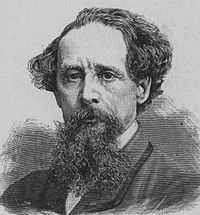
Charles Dickens - Project Gutenberg eText 13103.jpg Charles Dickens (7 February 1812 – 9 June 1870) was an English writer and social critic. He created some of the world's best-known fictional characters and is regarded as the greatest novelist of the Victorian era. His works enjoyed unprecedented popularity during his lifetime, and by the twentieth century critics and scholars had recognised him as a literary genius. His novels and short stories enjoy lasting popularity.
Born in Portsmouth, Dickens left school to work in a factory when his father was incarcerated in a debtors' prison. Despite his lack of formal education, he edited a weekly journal for 20 years, wrote 15 novels, five novellas, hundreds of short stories and non-fiction articles, lectured and performed extensively, was an indefatigable letter writer, and campaigned vigorously for children's rights, education, and other social reforms.
Dickens's literary success began with the 1836 serial publication of The Pickwick Papers. Within a few years he had become an international literary celebrity, famous for his humour, satire, and keen observation of character and society. His novels, most published in monthly or weekly instalments, pioneered the serial publication of narrative fiction, which became the dominant Victorian mode for novel publication. The instalment format allowed Dickens to evaluate his audience's reaction, and he often modified his plot and character development based on such feedback. For example, when his wife's chiropodist expressed distress at the way Miss Mowcher in David Copperfield seemed to reflect her disabilities, Dickens improved the character with positive features. His plots were carefully constructed, and he often wove elements from topical events into his narratives. Masses of the illiterate poor chipped in ha'pennies to have each new monthly episode read to them, opening up and inspiring a new class of readers.
Dickens was regarded as the literary colossus of his age. His 1843 novella, A Christmas Carol, remains popular and continues to inspire adaptations in every artistic genre. Oliver Twist and Great Expectations are also frequently adapted, and, like many of his novels, evoke images of early Victorian London. His 1859 novel, A Tale of Two Cities, set in London and Paris, is his best-known work of historical fiction. Dickens's creative genius has been praised by fellow writers—from Leo Tolstoy to George Orwell and G. K. Chesterton—for its realism, comedy, prose style, unique characterisations, and social criticism. On the other hand, Oscar WildeHenry James, and Virginia Woolf complained of a lack of psychological depth, loose writing, and a vein of saccharine sentimentalism. The term Dickensian is used to describe something that is reminiscent of Dickens and his writings, such as poor social conditions or comically repulsive characters.

Work Cited(参考文献)
"Charles Dickens." Wikipedia. Wikimedia Foundation, n.d. Web. 06 June 2016.


lV. My Reaction to A Christmas Carol

A.Summary
Ebenezer Scrooge, a bitter and miserly old moneylender, holds everything that embodies the joys and spirit of Christmas in contempt, keeping to himself and being nasty to people. Scrooge's buisness partner Jacob Marley has died and Scrooge is paying a man for his coffin. He pays him a very small amount and leaves. He walks throughout Victorian England, and as he passes people by everyone becomes quiet and frightend. He walks into his place of buisness and slams the door shut.

Seven Christmas Eve's later, he is still as bitter as he was before. He has an employee named Cratchit who is very poor and can barley afford food for his family. Scrooges nephew walks into the shop and asks to join him for dinner at his house, scrooge gives him an unfriendly Christmas hum-bug and tells him to leave. Closing time comes and Cratchit leaves. Scrooge closes up shop and goes home.

That night, Scrooge is visited by the ghost of his former business partner, Jacob Marley, who is now forced to spend his afterlife carrying heavy chains forged from his own greedy ways. Scrooge looks out the window and sees many more ghosts suffering the same fate. Marley warns Scrooge that he will suffer an even worse fate if he doesn't repent, and foretells that he will be haunted by three spirits that will help guide him.

The first spirit, the Ghost of Christmas Past, a small ghost made of fire, shows Scrooge visions of his own past that take place on or around the Christmas season, reminding him of how he ended up the greedy man he is now. He had spent much of his childhood neglected by his father over the holidays at boarding school until he was finally brought home by his loving sister Fan, who died prematurely after giving birth to his nephew Fred. Scrooge later began a successful career in business and moneylending and became engaged to a woman named Belle, though she later called off the engagement when he began to grow obsessed with accumulating his own wealth. Unable to bear having to witness these events again, Scrooge extinguishes the spirit. (The spirit sends scrooge soaring over london and he crashes through his ceiling into his bed)

Scrooge walks into a room, and finds it is covered in Christmas decorations. The ghost of Christmas present is in there waiting for him.

The Ghost of Christmas Present shows Scrooge the happiness of his fellow men on Christmas day. Among them are his nephew Fred, who playfully makes jokes with his family at Scrooge's expense, and Bob Cratchit and his family, who are just barely able to make do with what little pay Scrooge gives Cratchit. The Cratchits also tend to a sickly young son, Tiny Tim, whose commitment to the spirit of Christmas touches Scrooge, who is dismayed to learn from the spirit that he may not have much longer to live. Before the spirit vanishes, it warns Scrooge about the evils of Ignorance and Want, showing them as terrifying, uncivilized children doomed to grow into savage, despicable individuals. The ghost then withers away into dust.

The third and final spirit, the Ghost of Christmas Yet to Come, shows Scrooge the final consequences of his greed. Tiny Tim has died, leaving the Cratchits to mourn him on Christmas. Scrooge has also died, though there is more comfort than grief in the wake of his funeral. In addition, Fred finds benefit from inheriting his wealth, and Scrooge is even robbed by his former maid. Unwilling to let this grim future come to pass, Scrooge begs to be given a second chance as the spirit forces him into his deep and empty grave leading all the way to Hell.

Scrooge awakens to find himself in his bed on Christmas morning, the three spirits having guided him over the course of one night, and immediately sets out to atone for his sins, making donations to the poor, attending Fred's dinner party, and giving Cratchit a raise to care for his family, allowing Tiny Tim to live. Scrooge spends the remainder of his life a new man embodying the spirit of Christmas itself.


B.Reaction Point--Characters
Characters are the people in the story.
・Scrooge-The chief character of this story.He is very cold-blooded and hate Christmas.
・Marley-He was the partner of Scrooge, but he died.
・The first ghost, the second ghost, and third ghost--The three ghosts appearing in front of Scrooge suddenly.

C.Reaction Point--Theme
Theme is the purpose the writer has for creating the story.
Theme of this story is three ghost coming at night of Christmas. And I think the important thing is "What should we do to find happiness?"

D. My General Opinion
I read this story many times.This book is easy to read and this story make me happy.


2016年5月10日火曜日

CALL Literary Reaction Journal

To Be or Not to Be by William Shakespeare
- A soliloquy from William Shakespeare's play 'Hamlet'


To be, or not to be: that is the question:

Whether 'tis nobler in the mind to suffer
The slings and arrows of outrageous fortune,
Or to take arms against a sea of troubles,
And by opposing end them?
To die: to sleep;
No more; and, by a sleep to say we end
The heart-ache and the thousand natural shocks
That flesh is heir to, tis a consummation
Devoutly to be wished.
To die, to sleep;
To sleep perchance to dream, ay, there's the rub;
For in that sleep of death what dreams may come
When we have shuffled off this mortal coil,
Must give us pause.
There's the respect
That makes calamity of so long life;
For who would bear the whips and scorns of time,
The pangs of disprized love, the law's delay,
The insolence of office, and the spurns
That patient merit of the unworthy takes,
When he himself might his quietus make
With a bare bodkin?
Who would fardels bear,
To grunt and sweat under a weary life,
But that the dread of something after death,
The undiscovered country from whose bourn
No traveller returns, puzzles the will,
And make us rather bear those ills we have
Than fly to others that we know not of?
Thus conscience does make cowards of us all;
And Is sicklied o'er
With the pale cast of thought
And enterprises of great pith and moment
With this regard their currents turn away,
And lose the name of action.
 
 
Audio Version


l.About the Poem
 
"To be, or not to be..." is the opening phrase of a soliloquy in the "Nummery Scene" of William Shakespeare's play Hamlet.

Works Cited(参考文献)
"To Be, or Not to Be." Wikipedia. Wikimedia Foundation, n.d. Web. 27 Apr. 2016.                                                  

ll.About the Poet


William Shakespeare (26 April 1564 – 23 April 1616) was an English poet, playwright, and actor, widely regarded as the greatest writer in the English language and the world's pre-eminent dramatist. He is often called England's national poet, and the "Bard of Avon". His extant works, including collaborations, consist of approximately 38 plays, 154 sonnets, two long narrative poems, and a few other verses, some of uncertain authorship. His plays have been translated into every major living language and are performed more often than those of any other playwright.

Works Cited(参考文献)
 "William Shakespeare." Wikipedia. Wikimedia Foundation, n.d. Web. 27 Apr. 2016.

lll.My Reaction

A.Reaction Point-theme
Theme of this poem is“TO BE OR NOT TO BE”. They are very famous words.


B.Reaction Point- Point of View
 A point of view in this poem is how does Hamlet think of dying.
   Second point is if he can answer “TO BE OR NOT TO BE”.


C.Reaction Point-Rhyme
  Poets often use rhyme but this poem doesn't use it. This poem is just conflict.

D.My General Opinion
 In my opinion, Hamlet thinks dying is a last resort which we do something.However, he can't answer about “TO BE OR NOT TO BE” because he is upset many feelings. Moreover, this poem use omissions which we don't see too much. For example, whether it is = whether' t is, sicklied over = sicklied o'er. This poem was written in the old days so their omissions were used in that days.