 The book was written at a time when the British were examining and exploring Christmas traditions from the past as well as new customs such as Christmas cards and Christmas trees. Carol singing took a new lease on life during this time. Dickens's sources for the tale appear to be many and varied, but are, principally, the humiliating experiences of his childhood, his sympathy for the poor, and various Christmas stories and fairy tales. A Christmas Carol remains popular—having never been out of print —and has been adapted many times to film, stage, opera, and other media.==Background == Dickens was not the very first author to celebrate the Christmas season in literature, but it was he who superimposed his humanitarian vision of the holiday upon the public, an idea that has been termed as Dickens's "Carol Philosophy". Dickens believed the best way to reach the broadest segment of the population regarding his concerns about poverty and social injustice was to write a deeply felt Christmas story rather than polemical pamphlets and essays. Dickens's career as a best-selling author was on the wane, and the writer felt he needed to produce a tale that would prove both profitable and popular. Dickens's visit to the work-worn industrial city of Manchester was the "spark" that fired the author to produce a story about the poor, a repentant miser, and redemption that would become A Christmas Carol. The forces that inspired Dickens to create a powerful, impressive and enduring tale were the profoundly humiliating experiences of his childhood, the plight of the poor and their children during the boom decades of the 1830s and 1840s, and Washington Irving's essays on old English Christmas traditions published in his Sketch Book (1820); and fairy tales and nursery stories, as well as satirical essays and religious tracts.
Work Cited(参考文献)
"Charles Dickens." Wikipedia. Wikimedia Foundation, n.d. Web. 06 June 2016.
ll. Version of the Novel in the Mass Media
A. Animation Version
B. Movie Version
lll. About the Author: Charles Dickens
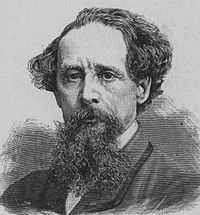 Charles Dickens (7 February 1812 – 9 June 1870) was an English writer and social critic. He created some of the world's best-known fictional characters and is regarded as the greatest novelist of the Victorian era. His works enjoyed unprecedented popularity during his lifetime, and by the twentieth century critics and scholars had recognised him as a literary genius. His novels and short stories enjoy lasting popularity.
Born in Portsmouth, Dickens left school to work in a factory when his father was incarcerated in a debtors' prison. Despite his lack of formal education, he edited a weekly journal for 20 years, wrote 15 novels, five novellas, hundreds of short stories and non-fiction articles, lectured and performed extensively, was an indefatigable letter writer, and campaigned vigorously for children's rights, education, and other social reforms.
Dickens's literary success began with the 1836 serial publication of The Pickwick Papers. Within a few years he had become an international literary celebrity, famous for his humour, satire, and keen observation of character and society. His novels, most published in monthly or weekly instalments, pioneered the serial publication of narrative fiction, which became the dominant Victorian mode for novel publication. The instalment format allowed Dickens to evaluate his audience's reaction, and he often modified his plot and character development based on such feedback. For example, when his wife's chiropodist expressed distress at the way Miss Mowcher in David Copperfield seemed to reflect her disabilities, Dickens improved the character with positive features. His plots were carefully constructed, and he often wove elements from topical events into his narratives. Masses of the illiterate poor chipped in ha'pennies to have each new monthly episode read to them, opening up and inspiring a new class of readers.
Dickens was regarded as the literary colossus of his age. His 1843 novella, A Christmas Carol, remains popular and continues to inspire adaptations in every artistic genre. Oliver Twist and Great Expectations are also frequently adapted, and, like many of his novels, evoke images of early Victorian London. His 1859 novel, A Tale of Two Cities, set in London and Paris, is his best-known work of historical fiction. Dickens's creative genius has been praised by fellow writers—from Leo Tolstoy to George Orwell and G. K. Chesterton—for its realism, comedy, prose style, unique characterisations, and social criticism. On the other hand, Oscar Wilde, Henry James, and Virginia Woolf complained of a lack of psychological depth, loose writing, and a vein of saccharine sentimentalism. The term Dickensian is used to describe something that is reminiscent of Dickens and his writings, such as poor social conditions or comically repulsive characters.
Work Cited(参考文献)
"Charles Dickens." Wikipedia. Wikimedia Foundation, n.d. Web. 06 June 2016.
lV. My Reaction to A Christmas Carol
A.Summary
Ebenezer Scrooge, a bitter and miserly old moneylender, holds everything that embodies the joys and spirit of Christmas in contempt, keeping to himself and being nasty to people. Scrooge's buisness partner Jacob Marley has died and Scrooge is paying a man for his coffin. He pays him a very small amount and leaves. He walks throughout Victorian England, and as he passes people by everyone becomes quiet and frightend. He walks into his place of buisness and slams the door shut.
Seven Christmas Eve's later, he is still as bitter as he was before. He has an employee named Cratchit who is very poor and can barley afford food for his family. Scrooges nephew walks into the shop and asks to join him for dinner at his house, scrooge gives him an unfriendly Christmas hum-bug and tells him to leave. Closing time comes and Cratchit leaves. Scrooge closes up shop and goes home.
That night, Scrooge is visited by the ghost of his former business partner, Jacob Marley, who is now forced to spend his afterlife carrying heavy chains forged from his own greedy ways. Scrooge looks out the window and sees many more ghosts suffering the same fate. Marley warns Scrooge that he will suffer an even worse fate if he doesn't repent, and foretells that he will be haunted by three spirits that will help guide him.
The first spirit, the Ghost of Christmas Past, a small ghost made of fire, shows Scrooge visions of his own past that take place on or around the Christmas season, reminding him of how he ended up the greedy man he is now. He had spent much of his childhood neglected by his father over the holidays at boarding school until he was finally brought home by his loving sister Fan, who died prematurely after giving birth to his nephew Fred. Scrooge later began a successful career in business and moneylending and became engaged to a woman named Belle, though she later called off the engagement when he began to grow obsessed with accumulating his own wealth. Unable to bear having to witness these events again, Scrooge extinguishes the spirit. (The spirit sends scrooge soaring over london and he crashes through his ceiling into his bed)
Scrooge walks into a room, and finds it is covered in Christmas decorations. The ghost of Christmas present is in there waiting for him.
The Ghost of Christmas Present shows Scrooge the happiness of his fellow men on Christmas day. Among them are his nephew Fred, who playfully makes jokes with his family at Scrooge's expense, and Bob Cratchit and his family, who are just barely able to make do with what little pay Scrooge gives Cratchit. The Cratchits also tend to a sickly young son, Tiny Tim, whose commitment to the spirit of Christmas touches Scrooge, who is dismayed to learn from the spirit that he may not have much longer to live. Before the spirit vanishes, it warns Scrooge about the evils of Ignorance and Want, showing them as terrifying, uncivilized children doomed to grow into savage, despicable individuals. The ghost then withers away into dust.
The third and final spirit, the Ghost of Christmas Yet to Come, shows Scrooge the final consequences of his greed. Tiny Tim has died, leaving the Cratchits to mourn him on Christmas. Scrooge has also died, though there is more comfort than grief in the wake of his funeral. In addition, Fred finds benefit from inheriting his wealth, and Scrooge is even robbed by his former maid. Unwilling to let this grim future come to pass, Scrooge begs to be given a second chance as the spirit forces him into his deep and empty grave leading all the way to Hell.
Scrooge awakens to find himself in his bed on Christmas morning, the three spirits having guided him over the course of one night, and immediately sets out to atone for his sins, making donations to the poor, attending Fred's dinner party, and giving Cratchit a raise to care for his family, allowing Tiny Tim to live. Scrooge spends the remainder of his life a new man embodying the spirit of Christmas itself.
B.Reaction Point--Characters
Characters are the people in the story.
・Scrooge-The chief character of this story.He is very cold-blooded and hate Christmas.
・Marley-He was the partner of Scrooge, but he died.
・The first ghost, the second ghost, and third ghost--The three ghosts appearing in front of Scrooge suddenly.
C.Reaction Point--Theme
Theme is the purpose the writer has for creating the story.
Theme of this story is three ghost coming at night of Christmas. And I think the important thing is "What should we do to find happiness?"
D. My General Opinion
I read this story many times.This book is easy to read and this story make me happy.

Hello, Yukari.
返信削除I have read this novel last year.
This story is affectingly.
I had happy because Scrooge did join the christmas party.
I thought It is important to kind for everyone.
Hi, Yukari,
返信削除Your blog is very interesting.
I'm interested in 'A Christmas Carol'.
I chose 'A Christmas Carol'.
Hello Yukari,
返信削除Thanks for this analysis. The best part of this post is the Reaction Points section. In this section, we can get a sense of what you really think about the novel of a work of fiction.
Hello Yukari,
返信削除Your blog is great! I lile this story.
I saw this movie some years ago. I want to see again!
Hi Yukari,
返信削除Your blog is so interesting.
I like this novel and make me happy too!!
I want to read this again.
Hello,Yukari.
返信削除Your blog is very nice.
I have seen it by an animated cartoon.
Hello,Yukari
返信削除this blog is very interesting for me.
I want to read this novel.
Hello Yukari.
返信削除Your blog is very nice.
I want to read this book.
Hi Yukari.
返信削除Your blog is very nice.
I want to look this movie.